Adam Smith
The Money and the Meaning
at the Temple
The Temple Was Always the Treasury
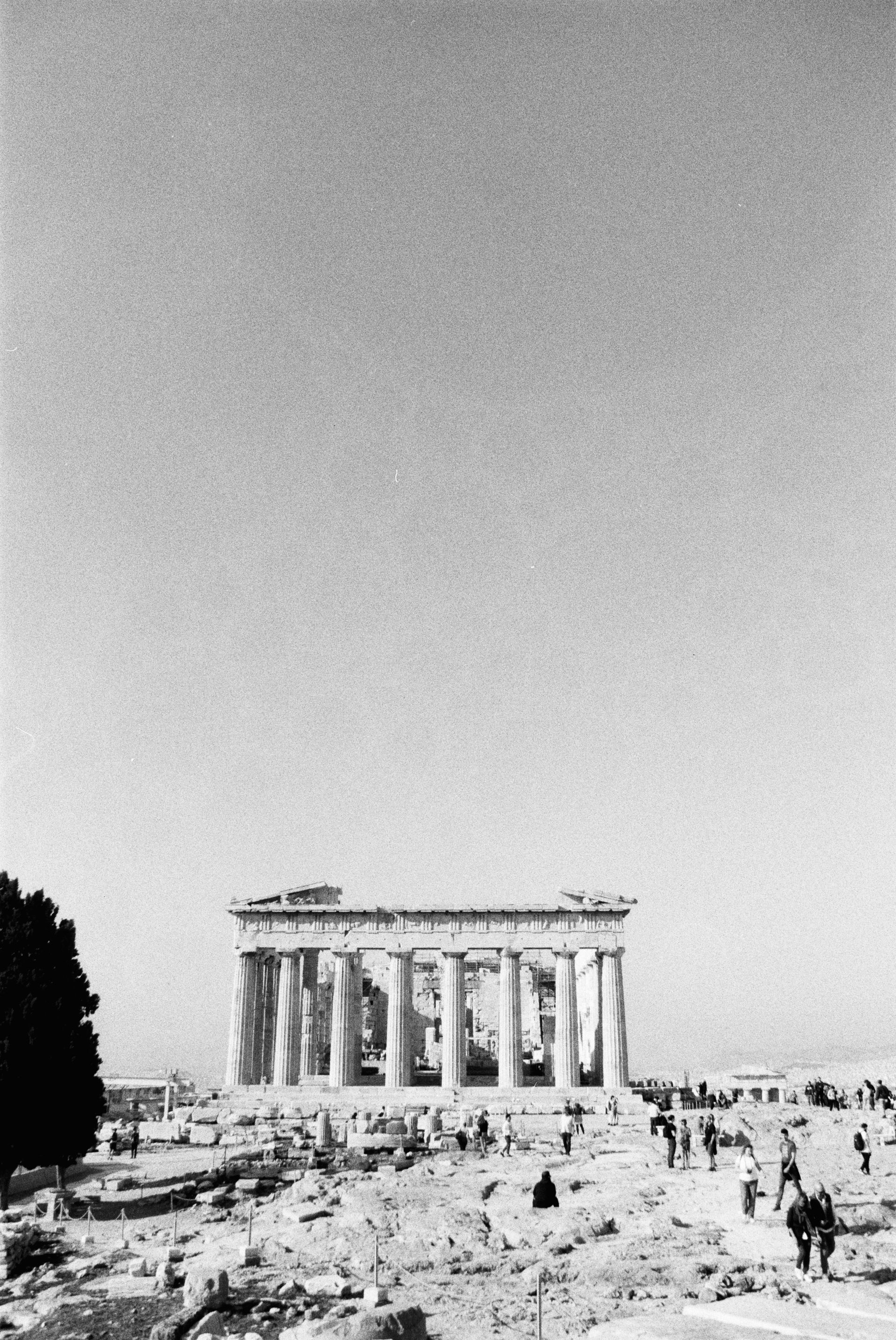
This paper emerged from a single observation: the Parthenon of Athens served simultaneously as the temple of Athena and the treasury of the Athenian city-state. The money and the meaning lived in the same building. The architecture was not awkward about it. Neither should we be.
What the Parthenon Actually Was
The Parthenon sits on the Acropolis in Athens, built between 447 and 432 BCE. It is widely understood as a religious monument – a temple to Athena Parthenos, goddess of wisdom, craft and warfare. The aesthetic achievement is undeniable: the proportions, the frieze, the columns, the scale. Western architecture has been attempting to recover from its influence ever since.
What is less foregrounded in the cultural memory of the Parthenon is its other function. It also served as the city treasury. The Delian League's financial reserves – tribute payments from allied city-states, accumulated over decades – were moved from Delos to Athens in 454 BCE and kept on the Acropolis alongside the sacred treasure of Athena. Historians generally place the reserve in the Parthenon's back chamber, the opisthodomos. Officials called the Treasurers of Athena kept the accounts. When the city needed funds, it borrowed from its goddess and recorded the interest it owed her.
The money and the meaning. In the same building. Under the same roof. Watched over by the same goddess.
They were the same legitimacy, expressed through different functions.
The temple said: this is real, this matters, this is protected by something beyond human appetite. And that is precisely what made it safe to put the money there. You don't rob Athena's house.
Pericles made the point himself. When Athens went to war with Sparta in 431 BCE, he set out the city's reserves for the assembly. Thucydides records how he finished.
"They might take even the gold ornaments of Athene herself; for the statue contained forty talents of pure gold and it was all removable. This might be used for self-preservation, and must every penny of it be restored."
Thucydides, reporting Pericles, History of the Peloponnesian War (c. 400 BCE)
This is not a quirk of ancient Athenian administration. It is the honest architecture of how meaning and money have always worked – not despite each other, but because of each other. Meaning conferred legitimacy on the money. The money conferred scale and durability on the meaning. The relationship was not incidental. It was structural.
When We Decided to Put Them in Different Buildings
The intellectual project of the Enlightenment – the 17th and 18th century effort to organise human life on rational rather than sacred foundations – is the moment the separation begins in earnest. Economics becomes a science. Commerce becomes mechanism. The market becomes a system that operates according to its own internal logic, independent of, and ideally uncontaminated by, matters of value, meaning or aesthetics.
Adam Smith, writing The Wealth of Nations in 1776, is often read as the founding document of this separation. The invisible hand. Self-interest as social good. The market as a self-correcting system. The reading is not entirely wrong – but it misses what Smith himself did not miss: that markets operate inside societies, and societies operate inside moral frameworks. Smith wrote The Theory of Moral Sentiments seventeen years before The Wealth of Nations. He understood that sympathy – the capacity to feel and care about others – was the actual foundation of economic life. The mechanism rested on the meaning.
The 200 years of economics that followed largely abandoned the foundation and kept the mechanism. The result is what Coolnomics calls naïve capitalism: a belief that commercial value can be created and measured in isolation from the human systems of meaning, resonance and judgement that actually generate it. It is one of two naïvetés. Working Paper 004 names the other.
Once you strip the sacred framing from economic life, you're left with pure mechanism pretending it has no values. Which is arguably more ideological than the temple ever was.
The Parthenon was at least honest about it. This is beauty, this is power, this is money, this is the city – here, in one building, under one roof, watched over by one idea. The Enlightenment separation did not produce a more honest economics. It produced an economics that hid its values in its methods, and called the hiding objectivity.
Post-Naïve Capitalism Is Not a New Idea
It's a Very Old One
Coolnomics positions itself as post-naïve capitalism – not anti-capitalism, not social impact capitalism, not conscious business. Those are all responses to the separation, trying to add meaning back onto a mechanism that was designed without it. Post-naïve capitalism refuses the premise of the separation in the first place.
The argument is not that cool and commerce should be reconciled. The argument is that they were never actually separate. The separation is the ideology. The original architecture – the temple that is also the treasury, the meaning that makes the money trustworthy, the resonance that precedes the transaction – that is the actual operating system of economic life. It has always been.
Every durable commercial success in history is a proof of this. The brands that last are not the ones that optimised their mechanism – they are the ones that maintained their meaning. The institutions that hold value across centuries do so because they hold a position in the culture that cannot be replicated by mechanism alone. The Parthenon is still drawing visitors 2,500 years after the treasury was emptied. Athena made the building worth protecting. The building made the gold worth guarding.
The separation is the problem.
The question is not how to make your business more meaningful or your meaning more commercial. The question is how to operate from the original architecture – where the meaning and the money are in the same building, and neither apologises for the other's presence.
What This Means for How You Build
The Legitimacy Problem
Most founders and strategists experience the money and the meaning as two separate pressures – the creative instinct pulling one way, the commercial requirement pulling another. This is not a personal failure. It is the inherited architecture of the separation. The discomfort is the ideology, not the reality. The original architecture has no such tension.
The Resonance Function
What made it safe to put the money in the temple was the resonance of the temple – the shared belief in its authority, its legitimacy, its connection to something real. Commercial resonance functions identically. People pay for things they trust. They trust things that resonate. Resonance is not a marketing problem – it is the foundational economic problem.
The Simultaneity Principle
The Parthenon did not alternate between being a temple on sacred days and a treasury on administrative ones. It was both, simultaneously, always. The cool and the nomics are not sequential – first make it good, then make it commercial. They develop in parallel, each sharpening the other. The Socratic dialogue between the idea and the money, where each pass improves both. That is the Coolnomics practice. That is what the building always was.
The Agora as Architecture
The Coolnomics Agora – the octagonal building that is simultaneously the product architecture, the website, the curriculum and the business model – is, in this reading, a direct descendant of the Parthenon logic. One building. The lecture and the commerce and the philosophy and the proof, all in the same house, not despite each other but because of each other. The temple was always the treasury. The Agora is both.
What This Paper Does Not Yet Resolve
This is a Working Paper – ideas in formation, not yet formalised into lecture or methodology. The following questions remain open and will be developed in subsequent iterations:
The Collapse Question
What happens when the temple loses its legitimacy? The Parthenon's treasury was eventually raided, the religion eventually replaced. Is there a structural vulnerability in fusing meaning and money so tightly – when the meaning fails, does the commercial structure collapse with it? And how does Coolnomics account for this?
The Scale Question
The Parthenon operated at the scale of a city-state. Does the fused architecture of meaning and money operate differently at the scale of a global economy? Or is the naïvety precisely the belief that mechanism can substitute for meaning at scale?
The Authenticity Question
The Greek citizen knew the temple was the treasury. There was no hidden logic. In contemporary commercial life, when a brand fuses meaning and money, is there an obligation of transparency about the fusion? Or is the fusion itself the honesty – the architecture visible for those who look?
In reverence to reality.
Where This Sits
This paper draws on Adam Smith's The Theory of Moral Sentiments (1759) and The Wealth of Nations (1776), on Thucydides' History of the Peloponnesian War and on the Parthenon as temple and treasury of Athens. Coolnomics synthesises these into the case for post-naïve capitalism: the meaning and the money were never separate.
Smith, Adam (1759) The Theory of Moral Sentiments. London: A. Millar.
Smith, Adam (1776) An Inquiry into the Nature and Causes of the Wealth of Nations. London: W. Strahan and T. Cadell.
Thucydides (c. 400 BCE) History of the Peloponnesian War, trans. Richard Crawley. London: J.M. Dent, 1910. Book 2, §13.
Hot Off the Press